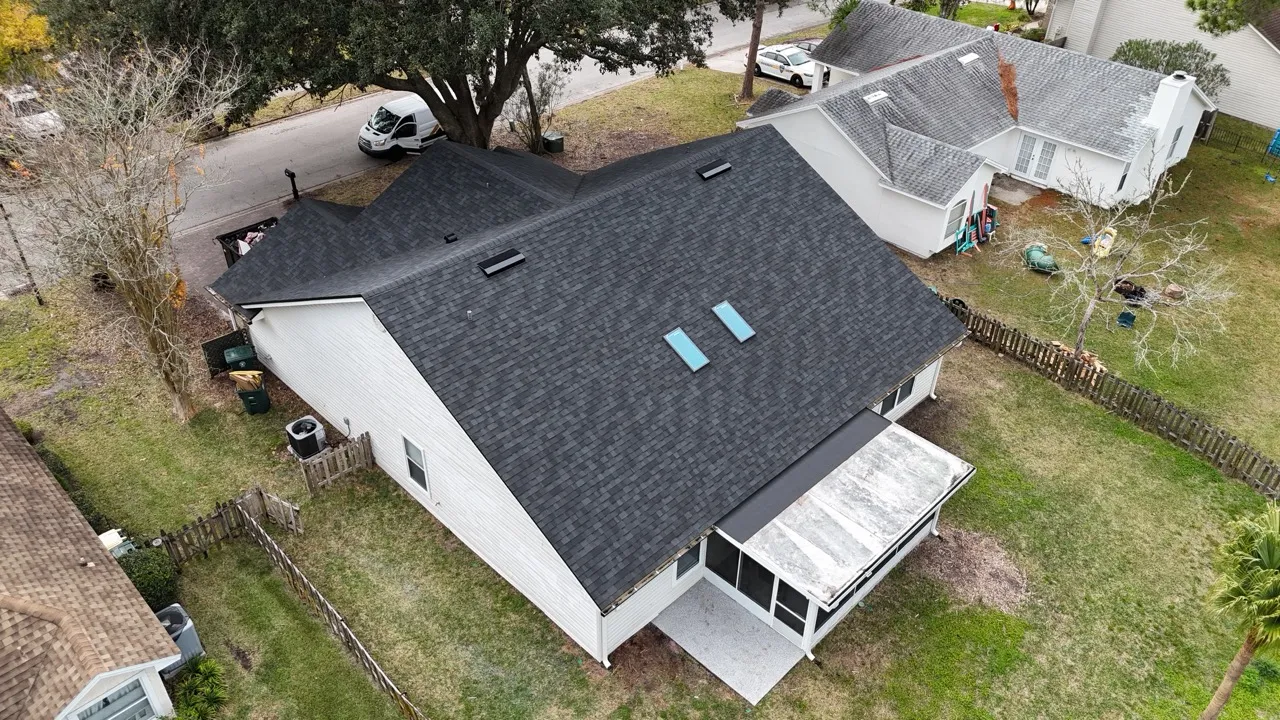

Drip Edge
Drip edge is metal flashing installed along the eaves and rakes of a roof that directs water into the gutters and away from the fascia, decking, and walls. It is required by the Florida Building Code on shingle roofs. Without it, water wicks back under the roofing and rots the structure below. Drip edge is included on every roof replacement we complete.
Drip edge is a small piece of metal that does an outsized job, especially in Northeast Florida where wind-driven rain is the norm during summer storms and hurricane season. It is one of the components most often skipped on cut-rate jobs, yet it protects the most vulnerable line on any roof. Whether you are planning a full roof replacement or building from scratch, understanding drip edge helps you spot a quality install from a corner-cutting one. If you are unsure whether yours is installed correctly, Gimo's Roofing offers free inspections across Jacksonville.
Drip Edge Functions:
- • Prevents water wicking under roofing
- • Directs runoff into gutters
- • Protects fascia from water damage
- • Supports shingle overhang at edges
What Drip Edge Does
The edge of a roof is where the roofing material stops and the structure below begins. That transition is a weak point. Water running down the roof surface wants to follow whatever surface it touches, a behavior called capillary action or wicking. At an unprotected edge, water curls under the bottom row of shingles, soaks into the wood decking, and runs down the face of the fascia board. Drip edge breaks that path. Its bent metal profile creates a clean, hard edge that forces water to drip free of the structure and fall into the gutter instead.
In practical terms, properly installed drip edge does four things at once. It directs runoff into the gutter trough rather than behind it. It shields the fascia, the vertical board that the gutters hang from, from constant moisture. It protects the exposed edge of the roof decking, the plywood or OSB the shingles are nailed to. And it gives the bottom course of shingles firm support so they can overhang the edge without sagging. On homes without gutters, it also throws water clear of the wall and foundation.
Why Drip Edge Is Required
Drip edge used to be considered optional, an upgrade some contractors offered and others skipped. That changed when it was written into the model building code. The International Residential Code section R905.2.8.5 now requires a drip edge at the eaves and rake edges of shingle roofs, and Florida adopts and enforces this through the Florida Building Code. You can review the model code language at the International Code Council and the state amendments at floridabuilding.org. In short, drip edge is no longer a nice-to-have. It is a code requirement that an inspector will check before passing a roof.
Without drip edge, the failures stack up over time:
- Water runs down the roof face directly onto the fascia board
- Water wicks backward under the bottom shingles and into the decking
- Fascia and soffit boards rot, often without being visible from the ground
- The exposed edges of the roof decking swell, delaminate, and crumble
- Runoff misses the gutter and concentrates at the foundation, eroding soil and risking water intrusion
In Florida, wind-driven rain makes all of this worse. During a thunderstorm or tropical system, rain does not fall straight down. Wind drives it sideways and even upward against the underside of the roof edge. Drip edge, combined with properly lapped underlayment, is the barrier that keeps that horizontal rain from being pushed up under the first course of shingles.
Need Professional Help?
Gimo's Roofing offers free inspections and estimates throughout Jacksonville and Northeast Florida. If your roof edges show rust, separation, or rot, our team can assess them and recommend roof repair or replacement.
Drip Edge Profile Types
Drip edge comes in several standardized profiles, named by letter. The right profile depends on whether it is going at the rake or the eave, and whether the home has gutters. A good crew uses the correct profile in each location rather than one piece everywhere.
Type C and Type L
- Simple L-shaped or angled profile with two flanges
- Commonly used at rakes, the sloped gable edges
- The least expensive and most basic option
- Lacks a lower kick-out, so it offers less control over where water drips
Type D and Type T
- T-shaped profile with a lower lip that kicks water outward
- Preferred at eaves, the lower edge where gutters hang
- The kick-out pushes water clear of the fascia and into the gutter trough
- Better long-term protection for the fascia than a plain L profile
Type F (Gutter Apron)
- Extended profile with a longer leading edge, also called a gutter apron
- Projects further out so it spans into the gutter or past the fascia
- Useful on reroofs over existing gutters and on homes without gutters
- Helps when the original roof edge sits short of the gutter line
Materials and Gauges
Drip edge is sold in standard ten foot lengths in a range of materials and thicknesses. Thickness is described by gauge for steel and by decimal inches for aluminum. Heavier metal holds its shape better under Florida sun and wind, while thin stock can flutter, dent, and pull loose over time.
- Aluminum: The most common choice in Florida. It will not rust, comes prefinished in many colors, and typically runs from about 0.019 inch on budget stock to 0.027 inch or heavier for a sturdier edge. Rust-proofing matters in a coastal, salt-air environment.
- Galvanized steel: Stronger and stiffer than aluminum, often in the 24 to 26 gauge range. It resists denting but the cut edges and any scratches can corrode over time, which is a real concern near the ocean.
- Copper: A premium, long-life option that pairs with copper gutters and develops a natural patina. Costly and usually reserved for high-end or historic homes.
- Vinyl: The cheapest option. It can become brittle and discolor under prolonged UV exposure, so it is rarely the right call for a sun-heavy Florida roof.
For most Jacksonville homes, prefinished aluminum at a respectable thickness gives the best balance of rust resistance, color match to the gutters, and longevity.
Proper Installation
The single most important thing to understand about drip edge is that the order of layers is different at the eaves than at the rakes. Getting this backward is one of the most common ways a roof edge fails, and it is easy to spot once you know what to look for. The rule is simple: at the eaves, drip edge goes under the underlayment; at the rakes, drip edge goes over the underlayment.
At Eaves (the Bottom Edge)
- Install the drip edge directly on the decking first, before the underlayment
- Lap the underlayment over the top flange of the drip edge
- This layering lets any water that reaches the underlayment drain out onto the drip edge and into the gutter, not behind it
- Fasten with roofing nails roughly every 12 inches, set back about 1.5 inches from the outer edge
At Rakes (the Side Edges)
- Install the drip edge over the underlayment along the sloped gable edges
- This sheds wind-driven rain off the surface and over the edge rather than trapping it
- Lap rake pieces over the eave drip edge at the corners so water flows downhill across the joints
- Set the shingles to overhang the drip edge by about 1/4 to 3/4 inch for a clean drip line
Pieces should overlap several inches end to end, with the higher piece always lapping over the lower one. Corners are mitered or overlapped so there is no open gap for wind-driven rain to enter. Done right, the finished edge looks straight and tight, and water that hits it has nowhere to go but down and out.
Common Installation Mistakes
- Reversing the layer order at the eaves, putting the underlayment under the drip edge instead of over it
- Failing to overlap adjacent pieces, leaving gaps that wind-driven rain pushes through
- Not extending the eave drip edge far enough into the gutter, so runoff falls behind it
- Nailing too close to the outer edge, which lets the metal lift and flutter in high wind
- Using thin, low-gauge stock that dents and pulls loose during a storm
- Skipping drip edge entirely to shave a few dollars off a bid, which also fails inspection
That last point is worth flagging on any estimate. Because drip edge is required by code, a bid that does not list it is either burying the cost or planning to leave it off. On a Florida roof, that is not a corner you want cut.
Signs of Missing or Failed Drip Edge
You can spot many drip edge problems from the ground or a ladder. Watch for these warning signs:
- No visible metal strip at all where the shingles meet the gutter or gable edge
- Rust streaks or staining running down the fascia from the roof edge
- Soft, peeling, or rotted fascia boards behind the gutters
- Water marks or staining on the soffit, the underside of the overhang
- Shingle edges that curl, sag, or are not supported at the perimeter
- Drip edge that has separated, bent, or lifted away from the roof
- Water spilling behind the gutter during rain instead of into it
- Peeling paint or interior stains near exterior walls at the roofline
If you see any of these, the fix is usually best handled during a reroof, because installing drip edge correctly at the eaves means lifting the bottom courses of shingles and the underlayment.
Drip Edge Cost
Drip edge is one of the more affordable parts of a roofing system. Aluminum material typically runs in the low single digits per linear foot, so the metal for an average home with a few hundred linear feet of roof edge usually lands in a range of a few hundred dollars. When it is installed as part of a full reroof, the added labor is minimal because the crew is already working the edges. As a standalone retrofit, the labor is higher because shingles and underlayment have to be disturbed and reset.
Heavier-gauge metal, copper, and custom color matches push the cost up. These are ranges that vary with roof size, edge length, material, and access, so treat any number you read online as a ballpark. The most accurate way to know your cost is a measured estimate. Drip edge is almost always included as a standard line item in a quality new construction roofing project, so for new builds the question is rarely whether you pay extra and more about confirming it is in the scope.
Get a Free Roofing Estimate
Instant online pricing or schedule an in-person assessment. Financing available from $99/month.
You Might Also Read
- Roof Anatomy Explained - Every part of your roof
- Best Roofing Materials for Florida - Complete comparison
- Roof Replacement Cost Jacksonville - 2026 pricing guide
Key Takeaways: Drip Edge
- • Required by Florida building code under IRC R905.2.8.5 on shingle roofs
- • Protects fascia and decking from wind-driven rain and wicking
- • Installation order matters, under the underlayment at eaves and over it at rakes
- • Use the right profile, Type D/T at eaves and Type C/L at rakes
- • Aluminum is standard in Florida, rust-proof and color-matched to gutters
- • Should be replaced during any reroof, not reused
Missing drip edge or seeing edge damage? Contact Gimo's Roofing for inspection. Call (904) 606-5313.


