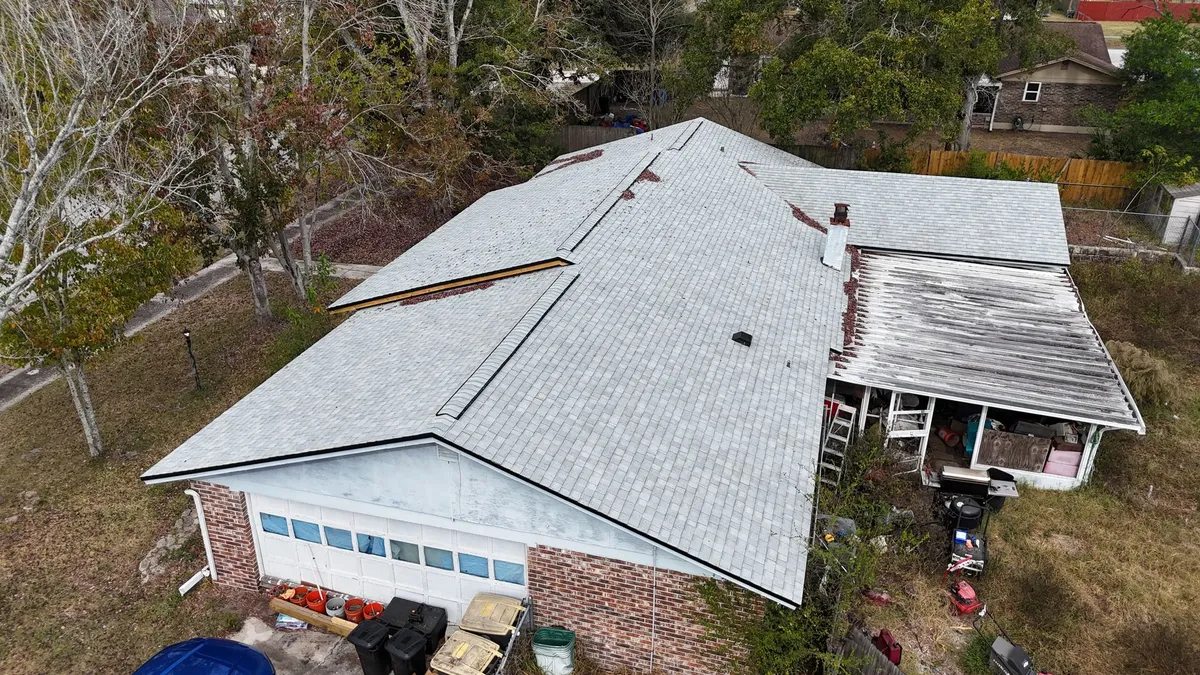

Roof Underlayment
Underlayment is the water-resistant layer installed between your roof decking and the shingles, tile, or metal covering. It is your roof's backup defense when water gets past the primary covering, and Florida code requires it on every roof. High-velocity hurricane zones require self-adhering underlayment across the entire deck for enhanced protection. Quality underlayment is standard on every roof replacement we install.
Underlayment selection is one of the most consequential decisions on any roof replacement, because it is the layer that keeps wind-driven rain out of your home after a hurricane strips shingles loose. It is also where manufacturer warranties live or die, since most shingle warranties require a specific underlayment system installed to spec. Homeowners across Jacksonville are increasingly upgrading from basic felt to synthetic and peel-and-stick systems, and the reasons become clear once you understand what each material does under a Northeast Florida sun and a Category 2 wind load.
Underlayment Types:
- • Felt (Tar Paper): Traditional, economical option in 15-lb and 30-lb weights
- • Synthetic: Stronger, tear-resistant, longer-lasting, lightweight
- • Self-Adhering (Peel-and-Stick): Best protection, seals around nail penetrations
Why Underlayment Matters
Most people picture shingles or metal panels when they think about what keeps rain out. In reality, the visible roof covering is only the first line of defense. It sheds the vast majority of water, but it is not a continuous waterproof membrane. Wind-driven rain forces water sideways and upward, under shingle tabs and through the nail holes that hold the roof down. When that happens, the underlayment is the only thing standing between the water and your roof deck, insulation, and ceilings.
In Jacksonville, this is not a rare event. Tropical systems, summer microbursts, and named hurricanes regularly push rain at angles that overwhelm the primary covering. After a storm tears a section of shingles loose, your home can sit exposed for days or weeks before a crew can repair it. During that window, the underlayment is doing all the work. A cheap, torn, or improperly lapped layer fails fast. A continuous self-adhered membrane can keep a house dry through an entire storm season even with missing shingles.
- Acts as a secondary water barrier if shingles, tiles, or panels are damaged or blown off
- Protects the roof deck from moisture during the days between tear-off and final covering
- Required by the Florida Building Code on all roof assemblies
- Provides critical protection during wind-driven rain, the leading cause of post-storm interior damage
- Earns insurance credits when a sealed roof deck or secondary water barrier is documented
- Prevents ice dam damage, though that is rare in Florida
Need Professional Help?
Gimo's Roofing offers free inspections and estimates throughout Jacksonville and Northeast Florida.
Types of Underlayment
Three underlayment families dominate Florida roofing: asphalt-saturated felt, synthetic, and self-adhered peel-and-stick. Each carries a different price, weight, and level of waterproofing. The right choice depends on your roof slope, your budget, the covering material, and how exposed your home is to coastal wind. Here is how they compare in practice.
Asphalt-Saturated Felt (Tar Paper)
Felt is the traditional underlayment, organic or fiberglass mat saturated with asphalt. It comes in two weights: 15-lb felt for budget and low-exposure jobs, and 30-lb felt, which is thicker, more tear-resistant, and the practical minimum for Florida shingle roofs. Felt is water-resistant rather than waterproof, and it remains a code-compliant choice in standard zones. Its weakness shows in heat: prolonged Florida sun makes felt dry out, wrinkle, and crack, and it absorbs water if it gets wet before the covering goes on. It also tears more easily underfoot, which can leave gaps if a crew rushes the install.
- Weights: 15-lb and 30-lb (30-lb preferred in Florida)
- Pros: Lowest material cost, proven track record, breathable so trapped moisture can escape
- Cons: Tears easily, absorbs water, wrinkles and dries out under high heat, heavier per roll
- Cost: Generally the least expensive of the three on a per-square basis
- Best for: Budget-conscious projects and steeper slopes that shed water quickly
Synthetic Underlayment
Synthetic underlayment is woven or spun polypropylene or polyethylene, the same family of plastics used in heavy-duty tarps. It is dramatically stronger than felt, resists tearing, lays flat without wrinkling in heat, and weighs a fraction as much, so a single roll covers far more area. Most products carry a UV exposure rating of roughly 90 to 180 days, which protects the deck if the project is delayed by weather. Synthetic does not absorb water and will not rot. The trade-off is a higher material price than felt, and some products are non-breathable, which makes proper attic ventilation important. For the majority of Jacksonville shingle and metal roofs, synthetic is the sensible standard.
- Material: Polypropylene or polyethylene, often with a slip-resistant walking surface
- Pros: High tear strength, UV-resistant for 90 to 180 days, will not wrinkle or rot, lightweight, safer to walk on
- Cons: Higher cost than felt, some grades are non-breathable
- Cost: A moderate step up from felt per square, offset by faster, safer installation
- Best for: Most Florida shingle and metal roof applications
Self-Adhering Peel-And-Stick (Modified Bitumen)
Self-adhering underlayment is a rubberized, modified-bitumen membrane with a sticky backing that bonds directly to the deck. Its defining feature is that it seals around every nail and fastener driven through it, so even when shingles or tiles are gone, water cannot find a path through the penetrations. Most peel-and-stick membranes run about 40 mils thick and many carry high-temperature ratings around 240 degrees Fahrenheit, which matters under dark roofs and metal in the Florida sun. This is the most waterproof option and the one that creates a true sealed roof deck. It is also the most expensive per square and the most labor-intensive to install, since the crew must align and roll each course carefully because the adhesive grabs on contact.
- Material: Rubberized modified-bitumen membrane, roughly 40 mils thick, with adhesive backing
- Pros: Self-seals around nail penetrations, best wind-driven rain protection, creates a sealed roof deck, high-temperature rated
- Cons: Highest material cost, slower and more skill-intensive to install, hard to reposition once set
- Cost: The premium tier, priced well above felt and synthetic per square
- Best for: High-wind coastal zones, low-slope sections, valleys, eaves, and around all penetrations
Florida Code Requirements
Underlayment is not optional in Florida. The Florida Building Code sets minimum underlayment standards statewide and tightens them sharply in the most hurricane-exposed regions. Two concepts drive these rules: the sealed roof deck and the secondary water barrier. Both describe an underlayment assembly engineered to keep water out even after the primary covering fails, which is exactly what happens in a major wind event.
Standard Areas (Including Most of Jacksonville)
- A single layer of approved underlayment is the minimum, mechanically fastened to spec
- Synthetic or 30-lb felt is acceptable across most of the field of the roof
- Self-adhering membrane is strongly recommended, and often required, at eaves, in valleys, and around penetrations
- Upgrading to a fully sealed roof deck earns wind mitigation insurance credits
High-Velocity Hurricane Zone (HVHZ)
- Full self-adhering underlayment is required across the entire roof deck
- The zone covers Miami-Dade and Broward counties and specific coastal areas
- Products must carry Florida Product Approval or a Miami-Dade Notice of Acceptance
- Always confirm current local amendments before any installation, since coastal jurisdictions can exceed the statewide minimum
Even outside the HVHZ, the secondary water barrier is the single most valuable underlayment upgrade a Northeast Florida homeowner can make. It documents a sealed roof deck for insurers and, more importantly, it is the difference between a damp attic and a flooded living room when the next storm peels shingles off. This is why we specify it on so many of our new construction roofing projects, where building it in from the start costs far less than retrofitting later.
Proper Installation
The best underlayment fails if it is installed wrong. The governing principle is simple: water always travels downhill, so every overlap must shed water over the course below it, never trap it. Crews start at the eaves and work up the slope, lapping each row over the one beneath so gravity carries runoff away from seams. Fastening pattern, lap width, and detailing around penetrations all matter as much as the material itself.
- Start at the eaves and work upward so each course laps over the one below it
- Overlap horizontal seams 2 to 4 inches and vertical end laps about 6 inches
- Use self-adhering membrane at the eaves, in all valleys, and around every penetration
- Extend the underlayment over the drip edge so water sheds cleanly off the roof
- Use cap nails or plastic-cap fasteners with synthetic, never staples, which tear and leak
- Cover underlayment with the final roof material promptly, since it is a backup layer and not designed for long-term sun exposure
Detailing is where experienced crews earn their keep. Valleys, pipe boots, chimneys, and skylights concentrate water and need self-adhered membrane wrapped tight to the deck. A missed lap or a staple gun in the wrong hands creates the exact leak path the underlayment was supposed to close.
Get a Free Roofing Estimate
Instant online pricing or schedule an in-person assessment. Financing available from $99/month.
You Might Also Read
- Roof Anatomy Explained - Every part of your roof
- Best Roofing Materials for Florida - Complete comparison
- Roof Replacement Cost Jacksonville - 2026 pricing guide
Key Takeaways: Roof Underlayment
- • Underlayment is your roof's backup water barrier and the last defense against wind-driven rain
- • Synthetic is the upgrade from felt for most Florida homes
- • Self-adhering peel-and-stick provides the best protection and creates a sealed roof deck
- • Florida code requires underlayment everywhere, and full self-adhered coverage in high-velocity hurricane zones
- • A secondary water barrier earns insurance credits and is worth the investment
Questions about underlayment? Contact Gimo's Roofing for guidance on your project. Call (904) 606-5313.


