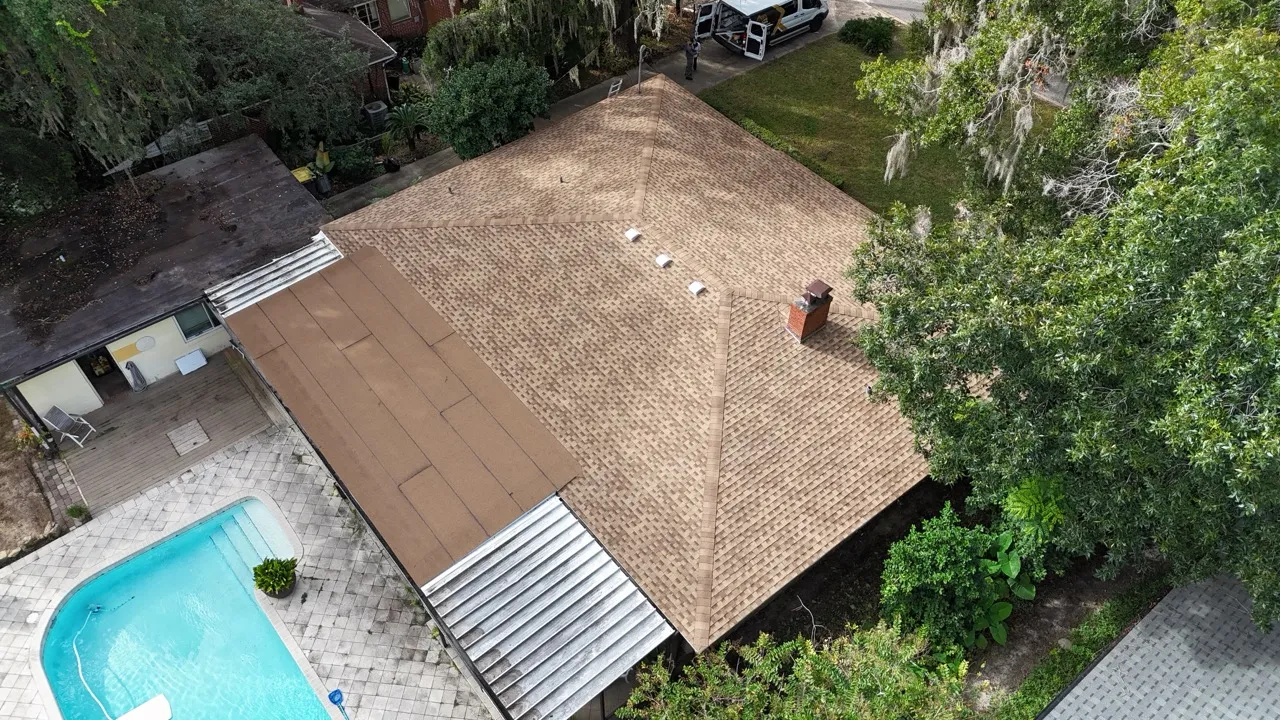

TPO (Thermoplastic Polyolefin) is the best flat roof option for most Florida commercial buildings and homes with flat or low-slope sections. It offers excellent heat reflection, strong seam welds, 20-30 year lifespan, and competitive pricing. EPDM works well for shaded applications, while modified bitumen suits complex roofs with many penetrations.
Florida Flat Roof Options: Quick Comparison
| Best Overall: | TPO (heat reflective, durable, cost-effective) |
| Budget Option: | EPDM (lower cost, but less energy efficient) |
| Complex Roofs: | Modified Bitumen (flexible, easy repairs) |
| Maximum Durability: | Built-Up Roofing (but heaviest and most expensive) |
What Is the Best Flat Roof Material for Florida?
For most Florida applications, TPO roofing is the best choice. Its white reflective surface significantly reduces cooling costs in our hot climate, the heat-welded seams create watertight connections, and it costs less than many alternatives while offering a 20-30 year lifespan.
However, the "best" option depends on your specific situation, building type, budget, existing roof structure, and priorities. Apartment buildings frequently use these flat systems, so if you manage one of those properties, our guide to multi-family roofing covers the added scheduling and tenant factors. Here's a detailed look at each option.
TPO Roofing: Best for Florida Heat
What Is TPO?
TPO (Thermoplastic Polyolefin) is a single-ply roofing membrane that's become the most popular commercial flat roof material in Florida. It's a synthetic rubber material that comes in large sheets welded together with hot air.
TPO Advantages for Florida
- Highly Reflective: White TPO reflects 80-90% of solar radiation, dramatically reducing cooling costs
- Heat-Welded Seams: Creates a monolithic waterproof membrane stronger than the material itself
- UV Resistant: Formulated to handle Florida's intense sun exposure
- Chemical Resistant: Handles rooftop equipment, grease, and pollutants
- Lightweight: Doesn't require structural reinforcement
- Lifespan: 20-30 years with proper installation
TPO Disadvantages
- Requires skilled installation (heat welding technique is critical)
- Some formulations have had durability issues (choose established manufacturers)
- Can puncture from foot traffic without walkway pads
TPO Cost in Jacksonville
TPO roofing typically costs $6-$10 per square foot installed in Jacksonville, including membrane, insulation, and labor. For a 10,000 sq ft commercial roof, expect $60,000-$100,000.
Need Professional Help?
Gimo's Roofing offers free inspections and estimates throughout Jacksonville and Northeast Florida.
EPDM Roofing: Budget-Friendly Option
What Is EPDM?
EPDM (Ethylene Propylene Diene Monomer) is a synthetic rubber roofing membrane. It's been used for over 50 years and has a proven track record. EPDM is typically black, though white versions are available.
EPDM Advantages
- Proven Durability: 25-30 year lifespan with proper maintenance
- Lower Cost: Generally the most affordable single-ply option
- Flexibility: Handles building movement and temperature changes well
- Easy Repairs: Can be patched with standard materials
- Puncture Resistant: Rubber membrane absorbs impacts
EPDM Disadvantages for Florida
- Heat Absorption: Black EPDM absorbs heat, increasing cooling costs significantly
- Adhesive Seams: Seams are glued rather than welded (potential failure point)
- White EPDM Costs More: Reflective white versions available but pricier
- Less Energy Efficient: Without white coating, significantly less efficient than TPO
EPDM Cost in Jacksonville
EPDM costs $5-$8 per square foot installed. It's less expensive than TPO upfront, but higher cooling costs may offset savings in Florida's climate.
Modified Bitumen: Versatile and Repairable
What Is Modified Bitumen?
Modified bitumen is essentially upgraded asphalt roofing. It combines traditional asphalt with rubber or plastic modifiers for improved performance, applied in layers with torch, hot mop, or self-adhesive backing.
Modified Bitumen Advantages
- Multi-Layer Protection: Typically 2-3 plies provide redundancy
- Easy Repairs: Familiar materials for most roofers
- Foot Traffic Friendly: Handles regular walking better than TPO/EPDM
- Versatile Installation: Works on complex roofs with many penetrations
- Lifespan: 15-20 years typical, up to 25 with maintenance
Modified Bitumen Disadvantages
- Less Reflective: Even with cap sheets, less energy efficient than TPO
- Fire Risk During Installation: Torch-applied methods require safety precautions
- Shorter Lifespan: Generally doesn't last as long as TPO or EPDM
- Heavier: Multiple plies add weight
Modified Bitumen Cost
Modified bitumen costs $5-$9 per square foot installed, depending on the number of plies and installation method.
Built-Up Roofing (BUR): Traditional Heavy-Duty Option
What Is Built-Up Roofing?
Built-up roofing (BUR) is the traditional "tar and gravel" flat roof. Multiple layers of asphalt-saturated felt are alternated with hot asphalt, topped with gravel or a reflective cap sheet.
BUR Advantages
- Maximum Durability: Multiple layers provide excellent protection
- Longest Track Record: 100+ year proven history
- UV Protection: Gravel surface blocks UV (no membrane exposure)
- Foot Traffic Handling: Handles regular walking and equipment
- Lifespan: 20-30+ years
BUR Disadvantages
- Heavy: 3-5 lbs per square foot (may require structural verification)
- Messy Installation: Hot asphalt creates fumes and odors
- Expensive: Labor-intensive installation costs more
- Leak Detection: Hard to find leaks in multi-layer system
- Limited Reflectivity: Unless using reflective cap sheet
BUR Cost
Built-up roofing costs $7-$12 per square foot installed, typically the most expensive flat roof option.
Flat Roof Materials: Side-By-Side Comparison
| Material | Lifespan | Cost/Sq Ft | Energy Efficiency | Best For |
|---|---|---|---|---|
| TPO | 20-30 years | $6-$10 | Excellent | Most Florida applications |
| EPDM | 25-30 years | $5-$8 | Poor (black) | Shaded roofs, budget projects |
| Mod Bit | 15-20 years | $5-$9 | Moderate | Complex roofs, high traffic |
| BUR | 20-30 years | $7-$12 | Moderate | Maximum durability needed |
Which Flat Roof Should You Choose?
Choose TPO If:
- Energy efficiency is a priority (it is in Florida!)
- You want the best value for commercial roofing
- The roof is fully exposed to sun
- You want modern, welded seam technology
Choose EPDM If:
- The roof is heavily shaded (trees, adjacent buildings)
- Budget is the primary constraint
- You're reroofing an existing EPDM roof
Choose Modified Bitumen If:
- The roof has many penetrations (pipes, units, curbs)
- Regular foot traffic is expected
- You want easy future repairs with common materials
Choose BUR If:
- Maximum durability is essential
- The building will have heavy equipment or traffic on the roof
- Budget allows for premium installation
At Gimo's Roofing, we install all flat roof types for Jacksonville commercial buildings and homes with flat sections. Our commercial roofing team will assess your building and recommend the best option for your needs.
Get a Free Roofing Estimate
Instant online pricing or schedule an in-person assessment. Financing available from $99/month.
You Might Also Read
- Roof Replacement Cost in Jacksonville FL - 2026 pricing guide
- How Long Does a Roof Last in Florida? - Lifespan by material
- Best Roofing Materials for Florida - Complete comparison
Key Takeaways: Flat Roof Options for Florida
- • TPO is the best overall choice for Florida's sunny, hot climate
- • Energy efficiency matters: White TPO can significantly reduce cooling costs
- • EPDM works for shaded roofs but costs more to cool if sun-exposed
- • Modified bitumen suits complex roofs with many penetrations
- • BUR offers maximum durability but at higher cost and weight
- • Lifespan ranges from 15-30 years depending on material and maintenance
Need a flat roof for your Jacksonville commercial building or home? Contact Gimo's Roofing for a free consultation. We'll assess your roof, discuss options, and provide transparent pricing. Call (904) 606-5313.

