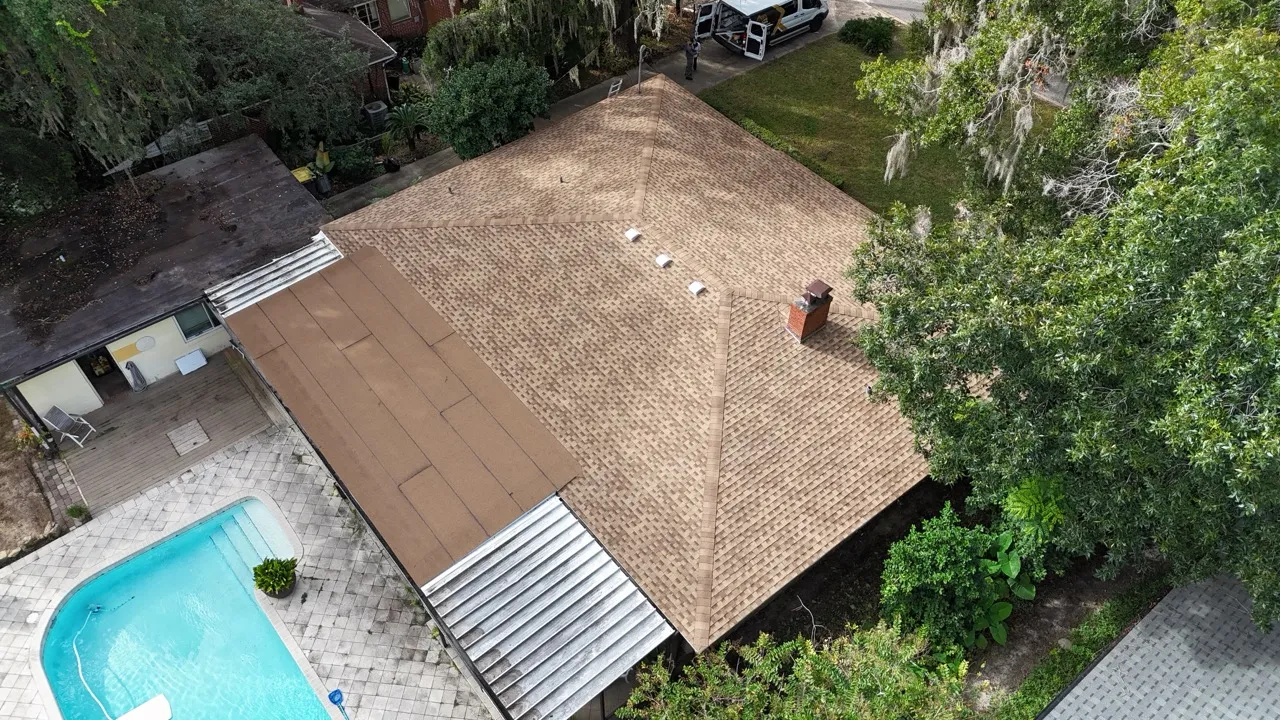
A gambrel roof is a two-pitch roof style with two sloped sections on each side, a shallow upper pitch and a steeper lower pitch, creating four roof planes total. It's the classic "barn roof" silhouette, originally associated with Dutch Colonial architecture in 17th-century North America. The design maximizes attic and second-floor headroom under a relatively short roofline, which is why it spread from barns to homes. Today gambrels are most common in the Northeast and Midwest, on agricultural buildings, and on barndominiums, and they're notably rare in Florida.
This guide covers what a gambrel actually is, how it's built, what it costs, the real pros and cons, and why you almost never see one in Jacksonville. Note up front: gambrel roofs are specialty work most Jacksonville roofers (us included) don't actively install on new builds, the design is heavily structural and the regional demand is essentially zero. If you have an existing gambrel home that needs material work like shingle replacement or repair, our roof replacement service can usually handle that even though new-build gambrels are outside our scope.
Gambrel roof at a glance
| Profile: | Two pitches per side, four roof planes total |
| Also called: | Barn roof, Dutch roof, Dutch Colonial roof |
| Origin: | 17th-century Dutch Colonial architecture, North America |
| Common use: | Barns, sheds, Dutch Colonial homes, modern barndominiums |
| Typical cost (home): | $15,000-$45,000 depending on size and material |
| Florida prevalence: | Rare, hurricane code and architectural tradition both discourage it |
What Is a Gambrel Roof?
A gambrel roof is a symmetrical two-sided roof where each side has two slopes: a shallow upper slope near the ridge and a steeper lower slope toward the eave. Where the two slopes meet on each side is the "knuckle" or breakpoint, the defining visual feature of the style. The result looks like a flattened-top barn roof viewed from the side.
The design's purpose is structural efficiency: the steeper lower slope creates more usable interior space (especially in the upper floor or attic) than a single-pitch gable roof of the same footprint and overall height. That's why early Dutch settlers used the form for both barns (more hay storage) and homes (more upstairs headroom).
Anatomy and Design of a Gambrel Roof
A gambrel has four primary components on each side:
- Upper slope: Typically pitched at 10°-30° (a shallow angle). This is the lighter, less wind-loaded portion of the roof.
- Lower slope: Pitched at 60°-80° (very steep). The steeper angle is what creates usable interior space below.
- Knuckle (breakpoint): The horizontal seam where the two slopes meet. Structurally and weatherproofing-wise, this is the critical detail.
- Eave: The lower edge where the steep slope meets the wall, similar to a gable eave but lower in profile.
Common gambrel pitch combinations:
- Traditional barn gambrel: 30° upper, 60° lower (steep, dramatic)
- Dutch Colonial home gambrel: 15°-22° upper, 70°-75° lower (more livable upstairs)
- Modern asymmetric gambrel: Custom angles, often used in contemporary barndominiums
Truss-built gambrels are the modern standard. Most are framed with pre-engineered gambrel trusses delivered to site, which speeds construction compared to stick-framing the rafters by hand. Stick-framing is still common on custom homes and historical restorations.
The Dutch Colonial Origin Story
The gambrel form arrived in North America with Dutch settlers in the 1600s, particularly in the Hudson River Valley, Long Island, and New Jersey. Dutch farmers used the shape on barns to maximize hay storage in the upper level (the steep lower slope let them stack hay nearly to the eaves without losing space to a low ceiling). The form transferred to homes for the same reason: more usable upstairs floor space under the same overall height.
By the 18th and 19th centuries, gambrels were strongly associated with Dutch Colonial Revival architecture, the style of formal two-story homes with symmetric facades, central doors, and steep lower roof slopes flaring out at the eaves. The Dutch Colonial Revival movement of the early 1900s spread the gambrel from the Northeast across the Midwest. Florida's architectural traditions (Spanish/Mediterranean Revival, Florida Cracker, Mid-Century Modern) developed without significant Dutch influence, which is one reason gambrels are uncommon in the state to this day.
Pros of a Gambrel Roof
Maximum Interior Headroom for the Roofline
The steep lower slope creates nearly full-ceiling-height space in the upper floor or attic. For barns, this means more storage. For homes, it means a livable second floor without dormers and without raising the overall roof peak. Square footage under a gambrel is often 25-40% greater than under a same-footprint gable.
Distinctive Classic Look
Gambrels are immediately recognizable and historically loaded. For Dutch Colonial restorations, modern barndominiums, and "farmhouse-style" new builds, the silhouette is a feature, not a compromise. It's also one of the few traditional roof forms that reads as both rural and architecturally sophisticated.
Material-Efficient Framing
A gambrel encloses more interior volume per board-foot of framing lumber than most alternatives. This made it economically attractive for early American builders working with limited materials, and the math still works on modern barndominium builds.
Easier to Retrofit Attic Space Later
If you eventually want to convert attic to living space, a gambrel makes the conversion much simpler than a gable, the steep walls give you usable height almost to the perimeter, and structural reinforcement is less invasive.
Cons of a Gambrel Roof
Wind Vulnerability
The gambrel's steep lower slope catches significant wind uplift in high-wind events. The breakpoint between the two pitches is also a structural weak point under sustained loading. In hurricane-prone regions, hip roofs significantly outperform gambrels, which is why Florida Building Code rewards hip and penalizes gambrel.
More Complex Flashing
The knuckle (where the two pitches meet) requires custom flashing details to prevent leaks. Done well, it's bulletproof; done poorly, it's the most common leak location on the entire roof. This drives up labor cost and demands a roofer with gambrel-specific experience.
Harder to Insulate Well
Because the upper floor is bounded directly by sloped ceilings rather than a flat attic, insulation has to go in the rafter bays rather than on an attic floor. This is more expensive and offers fewer R-value options. Modern spray foam helps, but the cost is higher than insulating a conventional gable.
Snow Load Concerns in Cold Climates
The shallow upper pitch can accumulate significant snow load in heavy-snow regions, requiring engineering for snow weight that a steeper roof wouldn't need. Not a Florida problem, but worth knowing for buyers considering gambrels in northern climates.
Resale Ceiling in Non-Dutch-Colonial Neighborhoods
Outside of regions where gambrels are traditional, the style can read as "out of place" to buyers. A gambrel home in a sea of ranch or contemporary homes may take longer to sell or comp at a discount.
Gambrel vs Gable vs Mansard
Gambrel often gets confused with other multi-pitch roof forms. Here's how the three most similar styles differ:
| Style | Slopes per side | Sides with slope | Origin | Best for |
|---|---|---|---|---|
| Gable | 1 | 2 | Universal | Most homes; simple, cost-effective |
| Gambrel | 2 | 2 | Dutch Colonial | Barns, Dutch Colonial homes, attic conversion |
| Mansard | 2 | 4 | French (17th c.) | Urban infill, maximum top-floor space |
The simplest way to tell them apart: gambrels look like barn roofs (two sides), mansards look like French chateau roofs (four sides, often with dormers), gables are just two slopes meeting at a peak. For broader context on roof types, see our roof types guide.
How Much Does a Gambrel Roof Cost?
Gambrel roof costs vary widely by application. Three typical scenarios:
- Gambrel shed (10x12 to 12x16): $1,500-$4,500 in materials for a DIY build; $4,000-$10,000 turnkey if you hire it out
- Gambrel barn or pole barn (1,200-2,400 sq ft): $20,000-$45,000 for the roof framing, sheathing, underlayment, and shingles or metal
- Gambrel-style home (1,800-2,500 sq ft): $15,000-$30,000 just for the roof; gambrel framing adds roughly 10-20% over a standard gable on the same footprint due to the more complex truss design and knuckle detailing
Cost factors specific to gambrels:
- Custom flashing at the knuckle adds labor cost compared to a continuous gable slope
- Steeper lower slope requires more safety setup (harnesses, roof jacks), slower install
- More waste in shingles or metal panels due to the four-plane geometry
- Specialty trusses if pre-engineered; or higher labor cost if stick-framed on site
For comparison shingle and metal pricing on standard residential roofs, see our roof replacement cost guide.
How to Shingle a Gambrel Roof
Shingling a gambrel follows standard residential roofing principles with a few critical gambrel-specific details. The general sequence:
- Deck inspection and underlayment. Same as any roof, but pay extra attention to the area at and below the knuckle, where leaks concentrate if anything goes wrong.
- Custom flashing at the knuckle. A continuous metal flashing or step flashing carries water down across the breakpoint. This is the single most important detail on a gambrel install.
- Drip edge at eaves and rakes. Standard practice, just more of it because gambrels have more eave length per square foot of footprint than gables.
- Start at the eave, work up. Shingles laid in standard course on the lower slope until you reach the knuckle, then a special transition course handles the pitch change.
- Continue up the upper slope. Once past the knuckle, standard course shingling resumes up to the ridge.
- Ridge cap and hip caps. Standard finish at the ridge; if the gambrel has hipped ends (rare), additional hip caps are needed.
Most shingle manufacturers (GAF, CertainTeed, Tamko, IKO) explicitly cover gambrel applications in their installation manuals. Architectural asphalt shingles are by far the most common choice; metal works too and can be striking aesthetically. For metal options that suit gambrel geometry, see our standing seam guide.
Gambrel Use Cases, Houses, Barns, and Sheds
Gambrels show up in three main applications, each with different design considerations:
Dutch Colonial Homes
The most architecturally formal gambrel. Two-story symmetric facades with a steep lower roof slope flaring at the eaves, central doors, dormers piercing the upper slope. Common in the Northeast, parts of the Midwest, and in some Florida historic neighborhoods (rarely). New-construction Dutch Colonials are uncommon today.
Barns and Outbuildings
The classic American red barn silhouette. Steeper lower slopes maximize hay storage; the form has been used on farm structures from the 1700s to today. Modern pole barns and equestrian barns frequently use gambrel for the same volumetric reason. In Florida, gambrel pole barns are still found on rural St. Johns, Clay, and Duval county properties.
Storage Sheds
The most common modern gambrel application by far. Backyard 10x12 and 12x16 storage sheds with gambrel roofs offer 25-40% more interior storage than gable sheds of the same footprint, and the silhouette reads as "intentional" rather than utilitarian. Both prefab and DIY plans are widely available.
Modern Barndominiums
A rapidly growing market segment: a residential interior built inside a barn-style metal exterior, often using a gambrel or modified gambrel profile. Barndominiums are surging in popularity in rural Northeast Florida (especially Clay, Nassau, and Putnam counties) for buyers wanting acreage living without the cost of conventional new construction.
Why Gambrel Roofs Are Rare in Florida
If you've spent any time in Florida and asked yourself why you almost never see gambrel roofs, the answer is three-part:
Hurricane Performance
Gambrel's two-pitch profile creates significant wind uplift on the steep lower slope and a structural flex point at the knuckle. Florida Building Code (FBC) gives wind-mitigation credit to hip roofs precisely because they shed wind loads better than gabled or gambreled forms. Building a gambrel to FBC standards in a 140 mph wind zone requires extra hurricane straps, sealed-deck membrane, reinforced trusses, and engineering review, which adds cost without unlocking insurance discounts.
Architectural Heritage
Florida's traditional architectural styles, Spanish/Mediterranean Revival, Florida Cracker, Old Florida vernacular, Mid-Century Modern, developed without Dutch Colonial influence. There's no regional tradition pulling builders, designers, or buyers toward gambrel. Even Florida's "farmhouse style" new construction trends toward gable forms with farm-style finishes, not actual barn-style rooflines.
Insurance and Resale Economics
Florida insurers price gambrel coverage higher (or refuse it) because of the elevated wind risk. And in resale, gambrel homes are harder to comp in neighborhoods where the form is uncommon. Both factors discourage builders and buyers from choosing the style.
Where You Might Still See Gambrel in Northeast Florida
- Rural barns and outbuildings on agricultural properties in Clay, Nassau, Putnam, and outer St. Johns counties
- Storage sheds in backyards (no wind certification required)
- Barndominiums on rural lots, growing market
- Historic Dutch Colonial homes (rare, mostly in older neighborhoods)
- Pole barns and equestrian buildings
Modern Gambrel Homes and Barndominiums
The traditional gambrel is having a quiet revival through the modern barndominium movement. New-build barndominiums are typically metal-clad, gambrel- or modified-gambrel-roofed structures with finished residential interiors. Three reasons buyers (especially in rural Florida) are choosing them:
- Cost per square foot: $80-$160/sq ft vs $200-$300/sq ft for conventional new construction
- Open interior volume: The gambrel form allows dramatic high-ceiling great rooms and lofts not easily achieved with conventional framing
- Acreage compatibility: The barn aesthetic fits rural lots better than suburban-style homes
The trade-offs: barndominium financing is harder to find (some lenders categorize them differently), insurance can be more expensive in Florida wind zones, and resale outside the rural-living buyer pool can be limited. For buyers committed to the lifestyle, the math often works; for buyers wanting flexibility, conventional construction may be the safer bet.
Key Takeaways
- • What it is: A two-pitch roof with shallow upper and steep lower slopes on each side, four planes total
- • Origin: 17th-century Dutch Colonial architecture, North America
- • Pros: Maximum interior headroom for the roofline, distinctive look, easy to retrofit attic space
- • Cons: Wind vulnerability, complex flashing at the knuckle, harder to insulate, resale ceiling in non-traditional regions
- • Cost: $1,500-$10,000 (shed), $20,000-$45,000 (barn), $15,000-$30,000+ (home), about 10-20% more than a gable of the same footprint
- • Florida prevalence: Rare due to hurricane code, architectural tradition, and insurance economics. Most common application locally is sheds and rural barns.
- • Modern resurgence: Barndominium movement is bringing the gambrel form back, especially on rural lots
If you have an existing gambrel home or barn in the Jacksonville area that needs shingle replacement, leak repair, or storm-damage assessment, our roof repair and roof replacement services cover material work on most gambrel structures. New-construction gambrels are specialty framing we typically refer to specialist crews, but for material work on existing gambrels, contact us at (904) 606-5313.