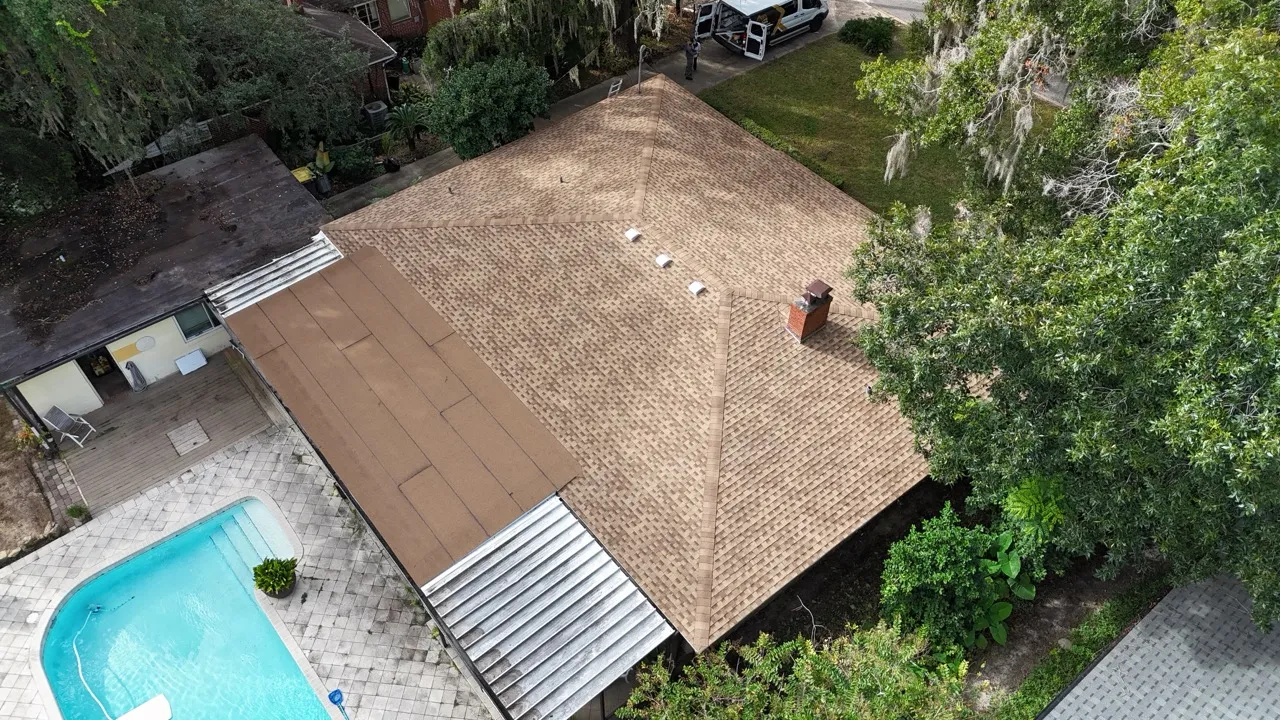
A standing seam metal roof is a metal roofing system where vertical panels are joined by raised seams that interlock above the panel surface, with fasteners concealed beneath. Panels run continuously from ridge to eave, eliminating horizontal seams. It costs $18,000-$35,000 installed on a typical 2,000 sq ft home, lasts 50-60+ years, and handles winds up to 160 mph, making it the longest-lasting and most hurricane-resistant residential roofing option available.
At Gimo's Roofing we install standing seam systems as part of our roof replacement service across Jacksonville and the surrounding beaches. The rest of this guide walks through what these roofs actually cost, the differences between panel types, how installation works, and when standing seam genuinely beats shingles, and when it doesn't.
Standing Seam Metal Roof at a Glance
| Cost: | $18,000-$35,000 (2,000 sq ft home) |
| Cost per sq ft installed: | $9-$17 (steel), $12-$20 (aluminum) |
| Lifespan: | 50-60+ years |
| Wind rating: | Up to 160 mph |
| Maintenance: | Annual inspection only |
| Best for: | Long-term homeowners, coastal homes, hurricane zones |
| Skip it if: | Selling within 5-7 years, budget-constrained, HOA-restricted |
Is a Standing Seam Metal Roof Worth It?
Standing seam is worth it for homeowners staying 15+ years in hurricane-prone or coastal areas. It lasts 50-60 years versus 15-20 for shingles, withstands 140-160 mph winds, and has concealed fasteners that eliminate the leak points common in screw-down metal roofs. It costs 2-3x more upfront, so the payoff is in years of ownership.
If you're selling within 5-7 years, budget-constrained, or your HOA restricts metal, shingles or stone-coated metal are usually the better fit. The rest of this guide walks through the system honestly, including the trade-offs roofers don't always volunteer.
What Is a Standing Seam Metal Roof?
A standing seam metal roof uses long vertical panels joined by raised seams that "stand" 1-2 inches above the flat pan surface. The seams either snap together over hidden clips or are mechanically folded shut on-site. Because the fasteners that attach the system to the deck sit beneath those seams, no screws are visible on the finished roof.
Defining characteristics:
- Raised seams: 1-2 inches above the flat panel
- Concealed fasteners: No exposed screws on the roof surface
- Continuous panels: Run ridge-to-eave with no horizontal seams
- Interlocking design: Panels lock mechanically for wind uplift resistance
- Material options: Galvalume steel, aluminum, copper, or zinc. Aluminum is preferred for coastal Florida
This is different from exposed-fastener metal roofing (sometimes called R-panel or 5V-crimp), where screws go through the panel face. Exposed-fastener systems are cheaper but rely on rubber washers that fail over time and become leak points. Standing seam eliminates that failure mode entirely.
Standing Seam Panel Types, Snap-Lock vs Mechanical Lock
"Standing seam" is a category, not a single product. The three profiles you'll be quoted differ in how the seam closes, which affects price, performance in high wind, and which roof pitches they suit.
When homeowners compare snap-lock vs mechanical lock standing seam, the trade-off is simple: snap-lock is faster to install and cheaper, while mechanical lock costs more but gives you the strongest weather seal and the best low-slope performance. On a typical 4:12 or steeper Jacksonville roof inland, snap-lock is plenty. If your roof is below 3:12, sits on the Intracoastal or oceanfront, or you live in a community that's seen direct hurricane damage in the last decade, mechanical lock is the smarter spend.
| Profile | How it joins | Cost tier | Best for | Brand examples |
|---|---|---|---|---|
| Snap-lock | Panels snap together over a hidden clip | $$ | Most residential, 3:12 pitch and steeper | Pac-Clad Snap-Clad, MBCI LokSeam, McElroy Medallion-Lok |
| Mechanical lock (single or double) | Seam is folded and crimped on-site with a seamer | $$$ | Low-slope (down to 1:12), coastal, high-wind | McElroy 138T, Berridge Cee-Lock, AEP Span Span-Lok |
| Nail-strip / batten | Hidden batten or nail flange concealed by the seam | $$ | Mid-range residential retrofits | Tamko MetalWorks, Englert A1300 |
For coastal Jacksonville homes, especially near Ponte Vedra Beach or the Intracoastal, a mechanical-lock aluminum system is the most weather-tight option. For inland Jacksonville on a typical pitched roof, a snap-lock Galvalume system delivers most of the benefit at a lower price point.
Standing Seam Metal Roof Pros
Exceptional Lifespan (50-60+ Years)
Standing seam routinely lasts 50+ years in Florida, potentially the only roof you'll ever buy. Aluminum lasts even longer because it doesn't rust, which matters in salt-air zones. For comparison, asphalt shingles in Florida average 15-20 years before replacement.
Superior Hurricane Protection
Standing seam is the strongest residential option for hurricane country:
- Wind ratings of 140-160+ mph, with many systems tested beyond their rated value
- Interlocking seams resist wind uplift
- Continuous ridge-to-eave panels eliminate weak transverse seams
- No exposed fasteners to back out or leak under cyclic wind loading
- Concealed clips allow thermal expansion without stressing the deck
Concealed Fasteners = No Leak Points
Every exposed screw on a roof is a leak waiting to happen. Standing seam hides every fastener beneath the seam, protected from UV and weather. That's why standing seam doesn't develop the long-term leak pattern that plagues exposed-fastener metal panels after 10-15 years.
Minimal Maintenance
No shingles to replace, no granules to wash away, no seams to re-caulk. The only ongoing task is an annual visual inspection and occasional debris clearing in valleys and behind dormers.
Energy Efficiency
Cool-roof Kynar/PVDF coatings reflect 70-80% of incoming solar radiation, cutting attic temps and reducing cooling costs 15-25% in Florida's climate. The air gap created by raised seams adds incremental insulation value.
Insurance Benefits
Florida insurers usually award maximum wind-mitigation credits for properly installed standing seam, and the roof remains insurable for decades while aging shingle roofs face dropped coverage. Pair with hurricane straps and a sealed roof deck to maximize the discount stack.
Standing Seam Metal Roof Cons
The main disadvantages of a standing seam roof are high upfront cost (2-3x shingles), potential noise during heavy rain without proper insulation, cosmetic denting from severe hail, color-match difficulty for future panel replacements, limited DIY repair feasibility, and possible HOA restrictions. None of these affect structural performance, but they're real trade-offs to weigh.
High Upfront Cost
The biggest barrier is sticker shock. Standing seam runs 2-3x more than quality architectural shingles on the same home. Financing options can spread the cost over 5-15 years if the lifetime math works for you.
Noise During Rain
Metal is louder than shingles in heavy rain or hail, but with modern synthetic underlayment, a solid deck, and proper attic insulation, the difference is usually minor. Bare-metal roofs over open framing (barns, sheds) are loud; conditioned homes with R-30+ attic insulation generally aren't.
Denting from Severe Hail
Golf-ball-and-larger hail can leave cosmetic dents on aluminum and lighter-gauge steel. Performance isn't affected, but the appearance is. Jacksonville sees serious hail rarely, so this is a minor risk locally; in hail-belt regions it's a bigger consideration.
Color Matching for Future Repairs
If a panel ever needs replacement, exact color match is hard because coatings fade over time. Most homeowners never face this, but it's worth knowing before you commit to an unusual color.
Limited DIY Repair
Standing seam repair needs specialized tools (seamers, panel benders) and knowledge of clip systems and thermal expansion. Use a contractor with documented metal experience, not a generalist shingle roofer.
HOA Restrictions
Some Jacksonville HOAs still restrict metal or require approved color palettes. Check your covenants before signing. Many associations have updated their rules in the last 10 years as metal's hurricane performance became widely documented.
How Much Does a Standing Seam Metal Roof Cost?
Standing seam metal roofs cost 2-3 times more than architectural shingles upfront. On a typical 2,000 sq ft Jacksonville home, expect $18,000-$35,000 for standing seam versus $7,900-$15,000 for quality shingles. Aluminum is roughly 20-30% more than Galvalume steel. Over a 50-year horizon, standing seam usually costs less per year of use because you avoid two or three shingle replacements.
Cost by Material
- Galvalume steel: $9-$13 per sq ft installed. Best balance of cost and 40-50 year lifespan.
- Aluminum: $12-$17 per sq ft installed. Doesn't rust, essential for coastal Jacksonville.
- Standing seam copper: $20-$40+ per sq ft. Premium aesthetic, 80-100 year lifespan.
- Zinc: $18-$28 per sq ft. Self-healing patina, architectural projects.
Cost by Home Size (Galvalume Snap-Lock, Baseline Installation)
- 1,500 sq ft home: $14,000-$20,000
- 2,000 sq ft home: $18,000-$26,000
- 2,500 sq ft home: $23,000-$33,000
- 3,000 sq ft home: $28,000-$40,000
What Drives the Cost Variance
- Roof complexity, hips, valleys, dormers, skylights, penetrations
- Roof pitch, steeper pitches are slower and need more safety setup
- Panel profile, mechanical-lock costs 15-25% more than snap-lock
- Coating quality, Kynar 500 / PVDF lasts longest and adds 5-10% to material cost
- Tear-off vs over-deck retrofit
- Decking repairs or upgrade to a sealed roof deck
For a full cost comparison with shingles and other materials, see our 2026 Jacksonville roof replacement cost guide and metal roof vs shingles comparison.
How a Standing Seam Metal Roof Is Installed
Installation is more involved than shingles and requires a crew trained on metal systems. The high-level sequence on a typical residential job:
- Tear off the existing roof and inspect the deck. Rotten or delaminated plywood is replaced. A sealed-deck membrane is often added at this stage for hurricane mitigation credit.
- Install high-temp synthetic underlayment. Metal roofs require an underlayment rated for the higher under-panel temperatures, typically a peel-and-stick high-temp membrane in Florida.
- Set drip edge, valley pans, and flashing. Custom-bent flashings are fabricated for valleys, sidewalls, chimneys, and skylights. This is where most leaks originate if done poorly.
- Run panels from eave to ridge. Panels are measured, cut, and snapped or seamed in place over concealed clips. Each panel locks to the next; clips allow the panel to expand and contract.
- Mechanically seam (if applicable). Mechanical-lock systems are folded shut with a powered seamer, single or double fold depending on the profile and wind zone.
- Install ridge cap, hip caps, and trim. Closures and venting components seal the top of the panel runs. Final inspection checks panel alignment, fastener concealment, and flashing seal.
Typical installation on a 2,000 sq ft home takes 3-6 days depending on complexity and weather. Standing seam labor runs about 30-40% of total job cost, so finding a crew with verifiable metal experience matters more than getting the lowest bid.
Standing Seam vs Other Metal Roofs
"Metal roofing" is a broad category. Here's how standing seam compares to the alternatives homeowners commonly consider:
The most common direct comparison we get asked about is stone-coated vs standing seam metal roofing. Stone-coated steel (Decra, Boral, Roser) uses pressed steel panels coated in stone granules to mimic the look of clay tile or wood shake, it solves an aesthetic problem standing seam doesn't, while keeping most of metal's wind and lifespan benefits. Standing seam wins on raw weather resistance, concealed-fastener leak protection, and modern architectural look. Stone-coated wins on traditional curb appeal, hail resistance from the granular cushion, and HOA approval in communities that ban "metal-looking" roofs. Cost is similar between the two; the choice is almost entirely about what you want the roof to look like from the street.
| Type | Cost | Lifespan | Fasteners | Notes |
|---|---|---|---|---|
| Standing seam | $$$ | 50-60+ yrs | Concealed | Best wind/leak performance |
| Exposed-fastener (R-panel, 5V) | $$ | 25-40 yrs | Exposed | Cheaper, washers fail at 10-15 yrs |
| Stone-coated steel (Decra, Boral) | $$$ | 40-50 yrs | Concealed | Looks like tile/shake, holds up to hail |
| Metal shingles (Tamko MetalWorks, Matterhorn) | $$$ | 40-50 yrs | Concealed | Shingle-style appearance, modular |
| Corrugated metal | $ | 20-40 yrs | Exposed | Mostly agricultural/outbuilding |
For more on metal options that mimic shingles or tile, see our benefits of metal roofing in Florida guide.
Who Should Choose Standing Seam (and Who Shouldn't)
Standing Seam Is the Right Call For:
- Long-term homeowners, 15+ years planned in the home
- Coastal and Intracoastal properties, choose aluminum to handle salt air
- Hurricane-zone homeowners prioritizing maximum wind resistance and insurance credits
- Modern or contemporary architectural styles
- Energy-conscious owners who want measurable cooling savings
- "Set and forget" priorities, you don't want to think about your roof again
Standing Seam Is the Wrong Call For:
- Selling within 5-7 years, you won't recoup the premium in resale
- Budget-constrained replacements, quality architectural shingles deliver 80% of the storm resistance at 40% of the cost
- HOA-restricted communities with no path to approval
- Rental properties where the lifecycle math rarely justifies the upfront premium
Gimo's Roofing installs standing seam, shingle, and other metal systems throughout Jacksonville and the surrounding beaches. Our roof replacement service includes a free consultation with honest pricing on every option that fits your home.
Key Takeaways
- • What it is: Vertical metal panels joined by raised, concealed-fastener seams
- • Lifespan: 50-60+ years (aluminum longest in coastal salt air)
- • Cost: $18,000-$35,000 on a 2,000 sq ft home, 2-3x shingles upfront
- • Wind rating: Up to 160 mph, the strongest residential option
- • Panel types: Snap-lock (most residential), mechanical-lock (low-slope/coastal), nail-strip (mid-range)
- • Best for: Long-term homeowners, coastal homes, hurricane zones
- • Skip it if: Selling soon, budget-tight, HOA-restricted
Considering standing seam for your Jacksonville home? Contact Gimo's Roofing for a free consultation. We'll measure your roof, explain the realistic options, and give honest pricing, no high-pressure sales. Call (904) 606-5313.