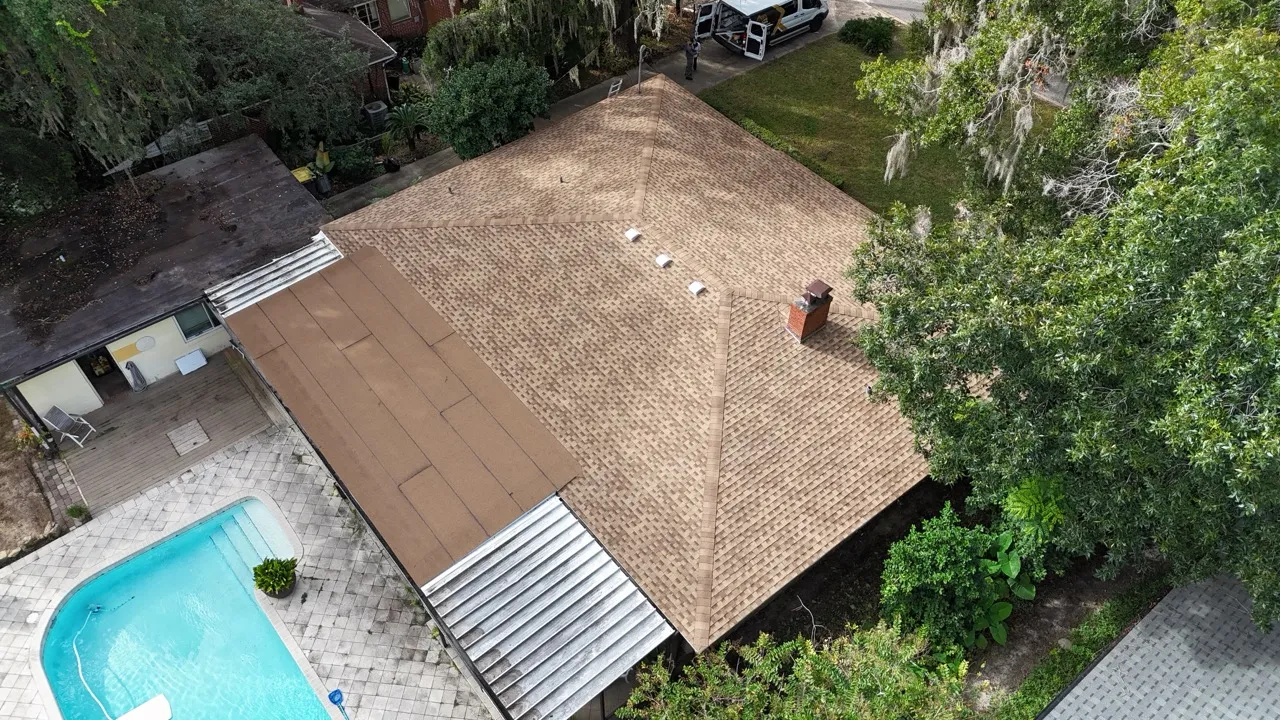
Roof sheathing is the flat structural layer of plywood or OSB that covers your roof's frame and provides the base that your entire roofing system attaches to. It is the most important component you cannot see from outside, and it is often the most expensive surprise on a roof replacement quote. Whether you are getting a roofing estimate, trying to understand why your roofer is recommending "wood replacement," or just want to know what is under your shingles, this guide covers everything Jacksonville homeowners need to understand about roof sheathing, also called roof decking.
Quick Answer - Roof Sheathing
- What it is: Plywood or OSB panels covering the roof frame, the base for everything above
- Common types: OSB ($15-25/sheet), Plywood ($30-45/sheet), Plank (older homes)
- Replacement cost: $60-110 per 4x8 sheet installed during a reroof
- Why it fails: Water infiltration, poor ventilation, age, improper installation
- Key fact: Damage is often hidden until old roofing is removed
What Is Roof Sheathing
Roof sheathing (also called roof decking) is the layer of flat panel material that covers the entire roof frame, spanning from rafter to rafter or truss to truss. It creates the solid, continuous surface that your underlayment, roofing material, and flashing all attach to. Without solid sheathing, your shingles have nothing to nail into, your underlayment has nothing to lay on, and your roof has no structural rigidity.
Think of your roof as a layered system built from the inside out. The rafters or trusses are the skeleton. The sheathing is the skin stretched over that skeleton. The underlayment is the waterproof membrane over the skin. And the shingles, metal, or tile are the outer armor. If any layer fails, the layers above it are compromised. But sheathing failure is the most consequential because it is the structural foundation for everything else. Weak, rotted, or delaminated sheathing means your shingles cannot hold, your nails pull free in wind, and water finds paths through soft spots.
Modern sheathing is almost always 4-foot by 8-foot panels of either OSB (oriented strand board) or plywood, typically 7/16-inch or 1/2-inch thick. Older Jacksonville homes, particularly those in Riverside, Springfield, and other pre-1960s neighborhoods, may still have original plank sheathing, individual boards nailed across the rafters with gaps between them.
Types of Roof Sheathing
OSB (Oriented Strand Board)
OSB is the most commonly used sheathing material in modern construction, accounting for the majority of residential roofing in the Jacksonville area. It is manufactured from wood strands arranged in cross-directional layers and bonded together with waterproof resin under heat and pressure. OSB is cost-effective at $15-25 per sheet, structurally strong, and provides a consistent, flat nailing surface. However, OSB has an important weakness for Florida homeowners: it is more susceptible to moisture damage than plywood. When OSB gets wet, the edges tend to swell permanently, creating visible bumps under your shingles. Once OSB begins delaminating from moisture exposure, it loses structural strength rapidly and must be replaced. This is why proper attic ventilation and prompt leak repair are so critical for homes with OSB decking.
Plywood (CDX)
Plywood is the traditional sheathing material, made from thin layers of wood veneer glued together with alternating grain directions. CDX-grade plywood is the standard for roofing applications, where the "X" stands for exposure-rated glue. Plywood costs more than OSB ($30-45 per sheet) but handles moisture significantly better. When plywood gets wet, it dries out and returns close to its original shape rather than permanently swelling like OSB. This moisture resilience makes plywood the preferred choice in coastal areas and high-humidity regions like Jacksonville. Many experienced contractors, including Gimo's Roofing, recommend plywood for Florida applications despite the higher cost because it provides better long-term durability in our humid climate.
Plank Sheathing (Skip Sheathing)
Found in homes built before the 1960s, plank sheathing consists of individual 1x6 or 1x8 boards nailed across the rafters, often with gaps between boards. This type of sheathing was designed for wood shakes, slate, and other heavyweight roofing materials that did not require a continuous nailing surface. Plank sheathing does not provide adequate support for modern asphalt shingles because the gaps between boards leave sections of underlayment and shingles unsupported. Homes with plank sheathing being reroofed with asphalt shingles typically need either complete resheathing (adding plywood or OSB over the planks) or at minimum, the gaps filled with additional boards. This adds $3,000-$8,000+ to a roof replacement project.
You Might Also Read
- Roof Anatomy - Every Part Explained - How sheathing fits into the full roof system
- Roof Underlayment Types for Florida - The layer that goes on top of your sheathing
- Roof Load Capacity in Florida - What your roof structure can handle
Why Roof Sheathing Fails in Florida
Sheathing does not last forever, and Florida's climate creates conditions that accelerate its deterioration. Understanding why sheathing fails helps you take preventive measures and understand why your roofer recommends replacement during a reroof project.
Water Infiltration - the Primary Killer
Water is the number one enemy of roof sheathing. When roof leaks go unaddressed, even small ones, water saturates the wood over time. The fibers swell, the structural bonds weaken, and rot sets in. OSB is particularly vulnerable because once its edge bonds break down from moisture, the entire sheet loses rigidity. Plywood handles intermittent wetting better but will still rot from sustained exposure. The insidious part is that sheathing damage from slow leaks happens invisibly beneath your shingles. By the time you see water stains on your ceiling or notice a sagging area on your roof surface, the sheathing in that area has likely been compromised for months or years.
Poor Attic Ventilation
Inadequate attic ventilation is the second most common cause of sheathing failure in Florida. Without proper airflow through soffit intake and ridge exhaust vents, Florida's humid air gets trapped in the attic space. This moisture condenses on the underside of the sheathing, especially at night when temperatures drop. Over time, this daily condensation cycle promotes mold growth, wood rot, and delamination from the bottom up, even if the roof covering above is perfectly intact and has never leaked. You can have a shingle roof in perfect condition and still have rotting sheathing if your attic ventilation is inadequate. This is one reason why Gimo's Roofing checks ventilation as part of every roof inspection.
Age and Wear
Even without visible water damage or ventilation problems, sheathing degrades with age. After 30-40 years, the resins that bind OSB strands or plywood veneers together begin to break down. The wood becomes softer, nails hold less firmly, and the structural capacity diminishes. Homes in Jacksonville that still have original sheathing from the 1970s or 1980s should expect at least partial sheathing replacement during their next roof replacement.
Improper Installation
Sheathing panels must be properly gapped (1/8-inch between sheets to allow for expansion), nailed with the correct pattern and nail type, and oriented with the strength axis perpendicular to the rafters. Improper installation, including wrong nail patterns, undersized panels, missing edge clips between rafters, or panels installed without expansion gaps, leads to premature failure. These installation defects are found during reroof projects and contribute to the need for partial resheathing.
Concerned About Your Roof's Sheathing?
If your roof is over 20 years old or you have had leaks, your sheathing may need attention. Gimo's Roofing provides free inspections including attic assessment of sheathing condition.
Signs Your Sheathing Needs Replacement
Some sheathing problems are visible from outside or from the attic. Others remain hidden until the old roof covering is removed during a replacement project. Here is what to watch for.
Signs Visible from Outside
- Wavy or uneven roof surface: If your roof has dips, ripples, or unevenness visible from the ground, the sheathing beneath those areas has likely softened or delaminated. Shingles conform to whatever surface they are nailed to, so bumps and valleys in the sheathing show through
- Visible sagging between rafters: If you can see the sheathing deflecting downward between rafter lines, creating a scalloped appearance, the panels have lost structural rigidity
- Soft or spongy areas: If a roofer walking on your roof reports soft spots, those areas have water damage or delamination underneath
- Shingles that do not lay flat: Curled or buckled shingles over a localized area may be caused by swollen or warped sheathing rather than shingle failure
Signs Visible from the Attic
- Daylight visible through the roof deck: If you turn off the attic lights and see pinpoints of light, those are holes or gaps in the sheathing that also allow water entry
- Dark water staining on the underside: Brown or black discoloration indicates past or current water exposure
- Visible rot or crumbling wood: Sheathing that crumbles when you press on it or has visible fungal decay is structurally compromised and must be replaced
- Delamination: OSB layers separating or plywood veneers peeling apart is a sign of moisture-related bond failure
- Mold growth: Fuzzy or discolored growth on the underside of sheathing indicates chronic moisture problems, typically from inadequate ventilation
How Much Does Sheathing Replacement Cost in Jacksonville
Sheathing replacement cost depends on the material type, the number of sheets needed, and whether it is part of a larger reroof project or a standalone repair. Here is what Jacksonville homeowners should budget.
Sheathing Replacement Costs (per 4x8 sheet, installed)
- - OSB (7/16"): $60-$85 per sheet installed
- - Plywood (1/2" CDX): $75-$110 per sheet installed
- - Average home total deck: 70-100 sheets needed for full coverage
Real-world scenarios during a Jacksonville roof replacement:
- Minor damage (5-10 sheets): $400-$1,000 additional cost. This is the most common scenario, a few sheets near old leak points or around penetrations that took water damage over the years
- Moderate damage (15-25 sheets): $1,200-$2,500 additional cost. Common on roofs that had deferred maintenance or multiple past leaks that were patched but left moisture in the sheathing
- Extensive damage (40+ sheets): $3,500-$6,000+ additional cost. Found on roofs with chronic ventilation problems or long-neglected leaks that went unrepaired for years
- Complete resheathing: $5,000-$9,000 additional cost. Required when original plank sheathing cannot support modern materials or when damage is too widespread to repair selectively
Why Sheathing Cost Is the Biggest Surprise on Roofing Quotes
Here is the challenge that frustrates homeowners and contractors alike: the true condition of your sheathing cannot be fully assessed until the old roof is removed. A contractor can inspect from the attic, check for soft spots, and look for visible damage, but much of the sheathing is covered by insulation and is inaccessible until tear-off day. This means sheathing replacement is often a variable cost item on a roofing estimate rather than a fixed number.
A reputable contractor handles this transparently. At Gimo's Roofing, we discuss the likelihood of sheathing damage based on roof age and visible condition during the estimate, provide a clear per-sheet price in the contract so you know the cost before they start cutting, contact you during the project to discuss findings and get approval before replacing any sheathing, and document all replaced sections with photos so you can see exactly what was damaged. This approach eliminates surprises while being honest about what cannot be known in advance.
Red Flag Warning
Be wary of roofing quotes that do not mention potential sheathing costs at all. Either the contractor has not inspected properly, they are planning to add these costs as a surprise change order after tear-off, or they intend to install new shingles over damaged sheathing (which will cause premature failure). Always ask: "What do you charge per sheet if sheathing needs replacement?" If the contractor cannot give you a clear per-sheet price, look elsewhere.
OSB vs Plywood for Roof Sheathing in Florida
This is one of the most common questions Jacksonville homeowners ask during a reroof project. Both OSB and plywood meet code requirements and perform adequately, but there are meaningful differences for Florida's climate.
OSB vs Plywood Comparison
- - Cost: OSB $15-25/sheet vs Plywood $30-45/sheet
- - Moisture resistance: OSB swells permanently when wet vs Plywood recovers when dried
- - Strength: Comparable for roofing applications
- - Nail holding: Both adequate, plywood slightly better at edges
- - Florida recommendation: Plywood preferred for coastal/humid areas
- - Availability: Both readily available from Jacksonville suppliers
For most Jacksonville homes, Gimo's Roofing recommends CDX plywood for replacement sheathing in our humid climate. The extra $15-20 per sheet translates to a total premium of only $75-$200 for a typical 5-10 sheet replacement, a modest investment for significantly better moisture performance over the next 20-30 years. For full resheathing projects where cost is a larger factor, quality OSB is an acceptable alternative when paired with proper ventilation.
You Might Also Read
- Roof Replacement Cost in Jacksonville FL - How sheathing fits into total project cost
- Roof Ventilation in Florida - Prevent sheathing damage from poor airflow
- Cleanup After Roof Replacement - What to check after the crew leaves
- How to Choose a Roofing Contractor - Find contractors who are transparent about sheathing
How to Protect Your Roof Sheathing
Since sheathing replacement adds significant cost to any roof project, protecting the sheathing you have extends the life of your entire roofing system and reduces future replacement costs.
- Fix leaks immediately. Even a small roof leak that only drips during heavy rain is saturating sheathing with every storm. What starts as a $200 flashing repair becomes $1,000+ in sheathing replacement if left for a year
- Ensure proper attic ventilation. Balanced intake (soffit vents) and exhaust (ridge vents) airflow prevents moisture buildup that rots sheathing from below. This is the single most important preventive measure for sheathing longevity in Florida
- Maintain gutters. Clogged gutters cause water to back up under the roof edge, saturating the sheathing along the eaves, the area most susceptible to rot
- Get annual roof inspections. A professional can identify leak-prone areas, ventilation deficiencies, and early signs of sheathing problems before damage becomes extensive
Planning a Roof Replacement?
Get a transparent estimate that includes per-sheet sheathing pricing with no hidden surprises.
Key Takeaways - Roof Sheathing
- - Roof sheathing is the structural base your entire roofing system attaches to
- - OSB is cheaper but moisture-sensitive; plywood costs more but handles humidity better
- - Water infiltration and poor ventilation are the two biggest causes of sheathing failure
- - Damage is often hidden until old roofing is removed during replacement
- - Budget $60-110 per sheet for replacement during a reroof project
- - Most homes need 5-10 sheets replaced; extensive damage can require 40+ sheets
- - A reputable contractor provides per-sheet pricing upfront in the contract
- - Proper ventilation and prompt leak repair prevent most sheathing damage
Questions about your roof's sheathing condition? Gimo's Roofing provides free inspections including attic assessment throughout Jacksonville, Orange Park, Mandarin, Nocatee, and all of Northeast Florida. We will show you photos of what we find, explain what needs attention, and provide transparent pricing. Call (904) 606-5313 for a free assessment.